Skip to content
Marc CotterillSep 25, 2026, 1:45:02 PM7 min read

FCA 2026 High-Growth Findings: What Fintech Leaders Need to Know | Map Room

INTRODUCTION

SCALING WITHOUT losing control...

Growth is rarely something fintechs struggle to celebrate, but unfortunately success often creates its own problems. More customers, transactions, products, people, markets… more moving parts - scale doesn’t just create more volume, it creates an enduring future of demand and increased complexity, and therefore, rather more things capable of going wrong.

Suddenly, for high-growth firms, the processes, controls and governance that worked perfectly well yesterday start being asked some fairly unreasonable questions.

That is the challenge at the heart of the FCA’s 2026 high-growth firms review: whether the capability supporting a growing business is evolving quickly enough to keep pace with the business itself.

So, for fintech leaders, the message is not that growth should slow down – it’s that growth and control cannot be treated as separate conversations.

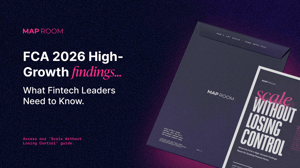
Scale without losing control - Blog Social Share-2
AT A GLANCE

WHAT ARE THE FCA's 2026high-growth findings?

The review considered how firms’ arrangements were developing as they grew, including:

REVIEW ITEM

Governance & Senior Oversight.

REVIEW ITEM

Risk Management.

REVIEW ITEM

Resourcing & scalability.

REVIEW ITEM

Systems/ Technology, Controls & MI.

REVIEW ITEM

Financial Resilience.

REVIEW ITEM

Consumer & Market Outcomes.

The FCA says the findings are particularly relevant to firms that are newly established, growing rapidly or undergoing significant change. Importantly, this is not a new standalone FCA rulebook for high-growth firms.

It is a good-and-poor-practice review. But the themes sit alongside existing regulatory requirements and guidance concerned with firms maintaining systems, controls and risk-management arrangements appropriate to the nature, scale and complexity of their activities. And the direction of travel is fairly clear.

FINDINGS

WHAT DID THE FCA find?

The stronger firms in the FCA’s review had generally allowed their operating capability to mature with the business.

That included clearer governance and accountability, better management information, more developed risk frameworks, investment in people and technology, stronger compliance capability and greater attention to whether resources could support future growth.


The weaker patterns tell the other side of the story.

The FCA identified areas including key-person dependencies, outdated frameworks and management information, insufficient knowledge transfer and resources that had not kept pace with increasing scale or complexity.

The problem is, none of this tends to happen all at once. A business can keep growing, hitting targets and looking perfectly healthy while the operating model underneath is quietly becoming more and more stretched.

FCA HIGH-GROWTH FINDINGS IMAGE

WHY DO THE FCA'S HIGH-GROWTH FINDINGS matter for fintech leaders?

Because growth changes more than just volumes.

A fintech entering a new market, launching a new product, changing its customer mix, adding a payments rail, acquiring another business or introducing more automation may also be changing:

  • Its risk profile;

  • Operational demand;

  • Control requirements;

  • Skills requirements; and

  • Governance needs.


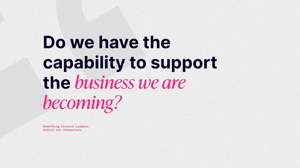
Therefore, leaders should ask themselves: Do we have the capability to support the business we are becoming?


Hiring more people is not always the answer, adding more controls is not always the answer, and automating more work is not automatically the answer either.

Sometimes the constraint is pure capacity. Sometimes it's process, skills, or techn. Sometimes it's governance. Often, it’s a combination unique to the organisation and their circumstances, and the operating model itself needs to change.

Getting the diagnosis wrong can be expensive.

THE BUSINESS WE ARE BECOMING QUOTE

HOW SHOULD HIGH-GROWTH FINTECHS THINK ABOUT governance & risk?

One of the strongest themes in the FCA findings is that arrangements which were appropriate at an earlier stage of a firm’s development may not remain appropriate indefinitely.

That applies to governance as much as anything else.

Founder-led decision-making, informal escalation routes or a heavy dependency on one or two experienced people may work perfectly well when a business is smaller.

At greater scale, those same arrangements can become bottlenecks.

The same is true of risk frameworks.

If the business has changed materially but the underlying assumptions, policies, customer-risk methodology or controls have not, there is a growing gap between the organisation on paper and the organisation actually operating today.

QUOTE IMAGE BG PINK-2
MAP ROOM'S view...

Our view is that risk assessment should therefore sit much closer to growth strategy.

When entering a new country, launching a new product or materially changing your customer population, the control and operational implications should be considered and impact-assessed up front, long before the change goes live - not handed to Compliance and Operations to solve for afterwards. Not quite as sexy as going all-in on growth, but your future P&L will thank you for it.

AMY JENKINS | HEAD OF REGULATORY EXCELLENCE | MAP ROOM

DOES SCALING MEAN adding more people?

Not at all. Headcount is only one component of effective capacity.

Twenty people don’t necessarily give you twenty units of useful capacity if work is repeatedly being reworked, complex cases queue behind a handful of approvers, QA keeps finding the same defects or the operation relies on overtime simply to maintain normal service.

Equally, growth today creates demand much further down the line; risk profiles change, customer populations need ongoing monitoring, and periodic and event-driven review activity creates more future operational demand.

And if that demand is then pushed back through the same processes that were already under strain, growth simply compounds the problem.

New customers you acquire today, become part of tomorrow’s queues. Therefore, understanding future demand - rather than just managing today’s - is one of the most important capacity questions scaling firms can ask.

WHAT DOES AI CHANGE FOR A scaling fintech?

The FCA’s high-growth review makes the point that increasing use of AI and other technologies changes the demands placed on risk management, governance, testing and operational resilience. Its Financial Crime Guide (FCG) makes a similar point on automated monitoring: firms need to understand what the technology can and cannot do, test that it is working as intended and consider the resource implications around it.

As tech takes on more repeatable activity, the role of people changes too. Human judgement becomes increasingly important around exceptions, investigation, escalation, quality assurance and oversight.

So, our view is that this capability should be designed deliberately. Know what the technology should do, where human judgement is still required – and adds most value, and how the two work together as one effective control.

DOWNLOAD OUR FULL GUIDE

SCALE WITHOUT
losing control

Access the full guide to explore the FCA’s 2026 high-growth findings in more detail

Scale without losing control - Blog Social Share-2
CONCLUSIONS

WHAT SHOULD SCALING FINTECHS do next?

The starting point is to treat growth and the capability required to support it as one connected plan.

If your Vision, Mission and OKRs are directing the business towards new markets, to launch new products, acquire customers faster or materially increase transaction volumes, then those ambitions should be balanced by equally explicit outcomes for the people, processes, technology and controls needed to support them - in practice, that means your Key Results shouldn’t measure growth alone - they should also tell you whether the operating model is evolving too - becoming more mature, and more capable of supporting the growth you seek.

Leaders should consistently ask themselves - what needs to be true of our people, processes, technology and controls for us to do that safely, sustainably and at scale?

Without that underlying blueprint, the pattern is predictable.

Growth happens. Pressure appears downstream. And teams become stretched - and before long, the organisation is firefighting the consequences of yesterday’s growth decisions.

The better answer is not to slow ambition down; it's to design the operating engine underneath such that it is ready to keep up. If growth is in your OKRs, the capability to support it should be too.

Map Room Primary Logotype Transparent Sized-1
GO DEEPER

SCALE WITHOUT
losing control

This article only scratches the surface about scaling with out losing control.

We’ve supported some of the UK’s best-known fintech and financial-services brands through periods of rapid growth, regulatory change and operating-model pressure - so we wanted to turn some of that experience into something practical others can use.

In our full Scaling Without Losing Control guide, we get into the FCA’s findings in more detail – what they mean in practice, exploring how scaling firms can identify where growth is beginning to put pressure on the operating model behind it.

The guide covers:

  • Five practical implications of the FCA’s findings for scaling fintechs
  • How to test whether governance is becoming a bottleneck
  • Why capacity is a control question, not simply a hiring question
  • How historic growth can create future CDD and review demand
  • What human-in-the-loop means for AI-enabled controls
  • A practical growth-trigger test for leadership teams
  • How to identify whether you have a capacity problem or a wider operating-model problem

SCALE WITHOUT
losing control

Access the full guide to explore the FCA’s 2026 high-growth findings in more detail - and the practical questions Operations, Risk and Financial Crime leaders should be asking as their businesses scale.


Take the growth-trigger pressure test and assess your firm.

Scale Without Losing Control - MockUp for Landing Page

NEED MORE THAN the guide?

If you're already feeling, we'd be happy to walk you through how we're supporting similar firms through growth, change and increasing operational complexity.

COMMENTS